Procedure
How to Serve the Defendant Without Losing Your Case
Service of process is the step that quietly decides cases. Get it wrong and a winning claim never gets heard.
By The CaseBySelf Team · 2026-05-20 · 6 min read
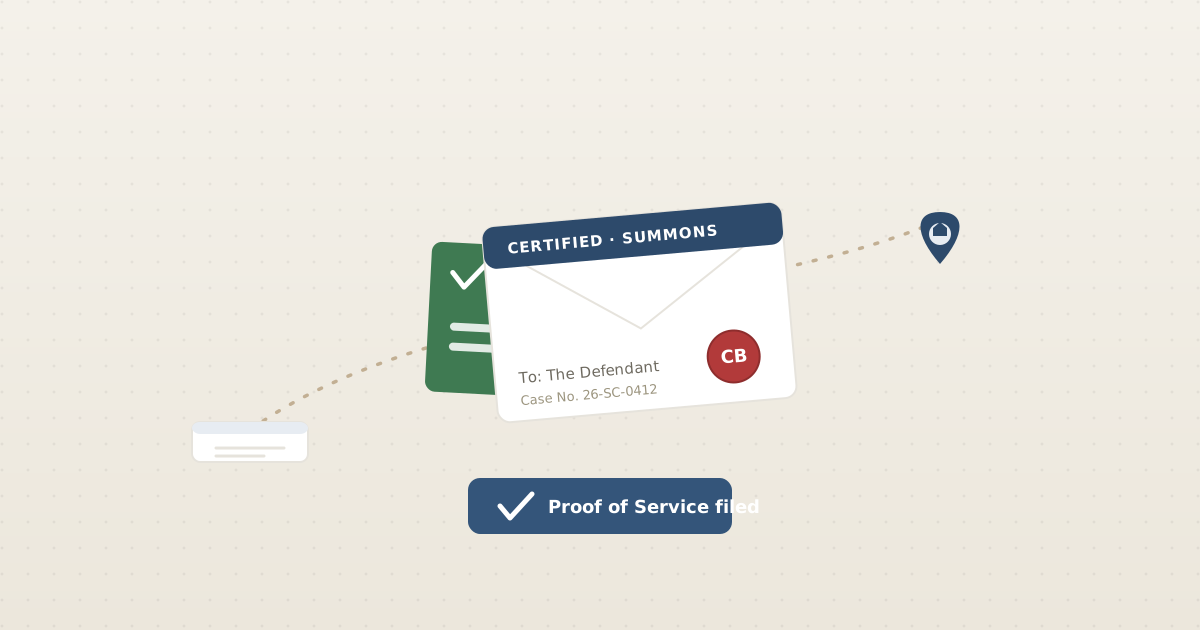
There is a quiet step between filing your case and arguing it that ends more claims than any bad argument ever could. It is called service of process, and it is simply the legal requirement that the person you are suing be properly told about it. The principle is foundational: no one can be ordered to pay without first being given proper notice and a chance to respond.
Why you cannot just tell them
Texting the defendant a photo of the paperwork does not count. Courts require service to happen in a specific, provable way so that no one can later claim they never knew. If you cannot show the court that service was done correctly, the judge will postpone or dismiss the case no matter how strong it is.
The methods courts accept
States vary, but small-claims service almost always comes down to a short menu:
- Certified mail. The cheapest option, often handled by the clerk. The signed return receipt is your proof. The catch: if the defendant refuses to sign, it can fail.
- Sheriff or marshal. For a modest fee, a law-enforcement officer hands the papers over and files proof with the court. Reliable, and hard to argue with.
- Private process server. A professional who specializes in finding and serving people, useful when the defendant is avoiding service. They provide a sworn affidavit of service.
- Personal service by an adult. Many states let any adult who is not part of the case hand over the papers and sign a proof of service.
Proof is the whole point
Whatever method you use, it produces a document, a signed receipt, an officer's return, an affidavit, that you file with the court. That filed proof is what lets the hearing go forward. Treat it as the real deliverable of this step, not the delivery itself.
Service is not done when the papers are handed over. It is done when you can prove they were.
When the defendant is dodging
Some people make themselves hard to find on purpose. If certified mail fails and an address is uncertain, a private process server is usually worth the cost. As a last resort, many states allow alternative service, such as posting and mailing, or even service by publication, but only after you show the court you made a real effort to find the person first.
Watch the deadline
Service has to be completed a set number of days before the hearing, and the whole case has a window in which service must happen at all. Start early. The most common service failure is not a clever defendant. It is a filer who waited too long and ran out of time before the date.