Money
How to Figure Out Exactly What You Are Owed
A number you can defend beats a number that sounds about right. Here is how to build a damages figure a judge will actually award.
By The CaseBySelf Team · 2026-05-29 · 6 min read
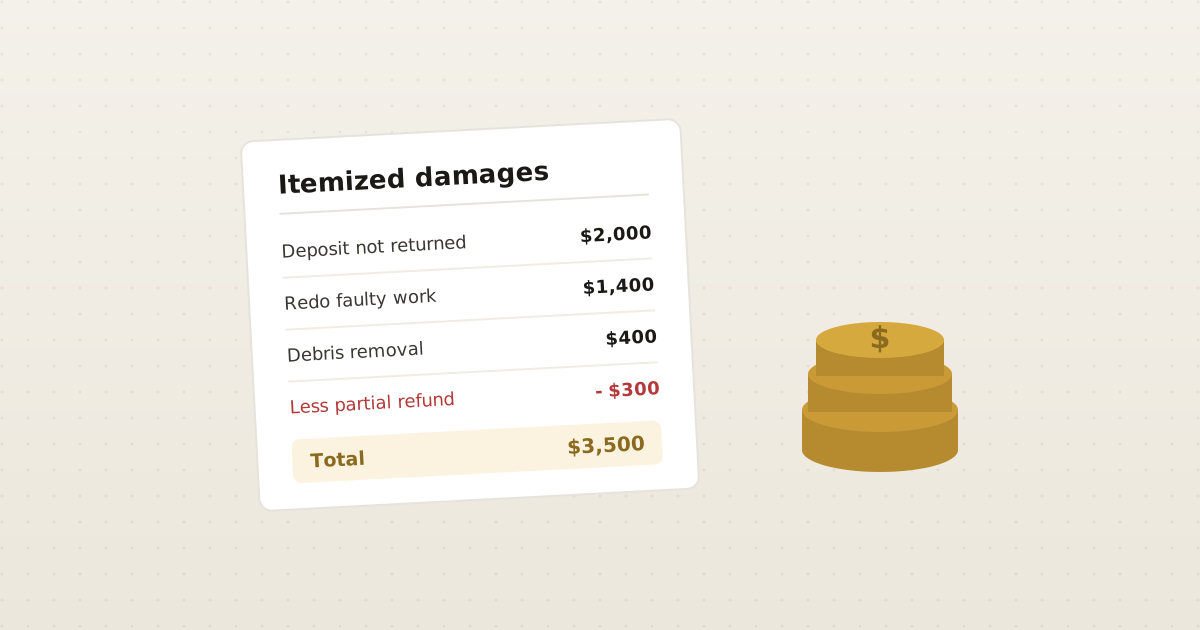
When people first decide to sue, they often pick a round, slightly angry number. The real figure is almost always different, and it is almost always more persuasive, because it can be backed up line by line. A judge cannot award you a feeling. They can award you a sum you have itemized and supported.
Start with what you actually lost
The core of most claims is your actual loss, the real, documented money the dispute cost you. If a contractor took a $2,000 deposit and never showed, your loss starts at $2,000. If a repair was done badly and a second company charged $1,400 to fix it, that $1,400 is your loss. Tie every dollar to a receipt, an invoice, or a statement.
Add costs that flowed from the problem
You can usually include costs that were a direct, foreseeable result of the other side's failure. A few common examples:
- The cost to redo or complete work that was left unfinished or done wrong.
- Out-of-pocket expenses you would not have had otherwise, like a rental car or emergency repair.
- Storage, late fees, or other charges that piled up because of the original failure.
Know what you usually cannot add
Small claims is built to make people whole, not to punish. In most states you will not get punitive damages, and you generally cannot bill for the hours you spent preparing the case or the stress it caused. There are exceptions written into specific statutes, like double or triple damages for certain landlord or consumer violations, but those are the exception, not the rule.
Aim for the number you can prove to the dollar, not the number that would feel like justice.
Subtract anything you got back
If the other side already refunded part of the money, or you resold the defective item, subtract it. Courts expect you to account for what you recovered, and showing that you did makes the rest of your number more believable. A claim that quietly ignores a partial refund invites the judge to distrust the whole figure.
Write the one-line ledger
Reduce all of it to a short table you can hand up: each item, the amount, and the exhibit that proves it. When your damages are a tidy list that adds to a specific total, you are no longer asking the judge to trust you. You are asking them to do arithmetic.